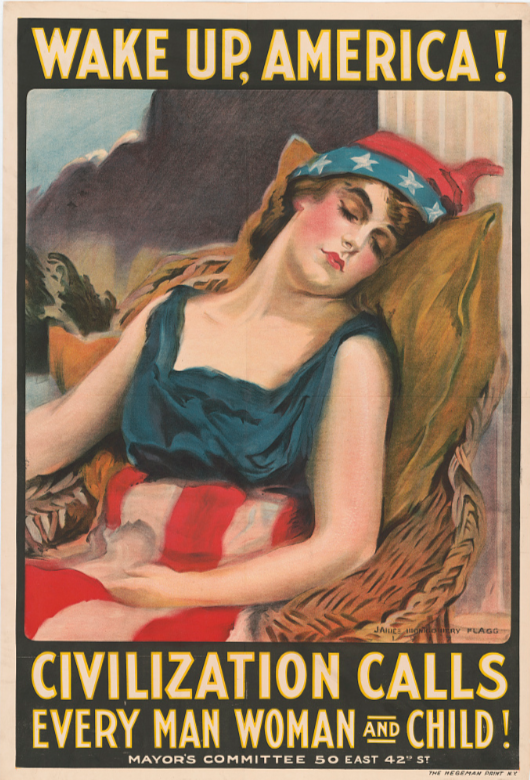
“Wake Up America!” is a recognizable work of WWI propaganda designed for the Mayor’s Committee on National Defense, a non-profit organization formed by city officials during the war in 1917. American artist, James Montgomery Flagg was commissioned by the committee to produce artwork supporting the military effort.1 Previously remaining neutral in the war effort, the United States was nearing intervention. Flagg was selected based on his past successful illustrations.2
The large poster image shows a young female sleeping peacefully while wrapped in the stars and stripes of the United States flag. The peacefulness of her pose is in stark contrast to the urgent call for action at the upper portion of the poster, which proclaims “Wake Up America!” The sleeping woman in the chair represents the United States as she sleeps unaware of the global situation developing around her. To fully comprehend this warning, one must look back to the historical climate of early 1917. The U.S. was still a very isolationist nation at this time; the great majority of Americans were wary of getting involved in any type of military conflict.3
The concept that neutrality represents a form of laziness is portrayed here, along with the message that if you continue to ‘sleep’ it could endanger your nation. This image exemplifies the popular propaganda tactics that were implemented during WWI. According to Historian Eberhard Demm in his book “Propaganda and Caricature in WWI”, nations going to war created imagery that had an emotional impact; they simplified messages and created story lines that were meant to provoke an emotion in citizens.4
A common theme was to personify a nation as a woman in need of assistance or was innocent and needed to be protected. In this case, Flagg borrows heavily from this method of personification; the female figure is attractive, innocent, and draped in the U.S. flag, thus calling upon you, the viewer, to feel a sense of obligation towards the well-being of your country.
The poster elevates the issue from a global political argument to a worldwide moral concern. Christian Mull and Matthew Wallin’s Propaganda: A Tool of Strategic Influence states that effective propaganda frames being involved in war as everything to do with protecting “civilization”, shared values, the structure of society.5 Flagg utilized this for his appeal: using the term “civilization” allows for a discussion of an ethical principle with the highest stakes; not taking part leads to negative effects.
Upon a deeper analysis, it contains many critical techniques. In the case of this poster, the representation of a nation is used as a character, making the concept of “America” more conceivable from an emotional standpoint. The bright colors associated with this country aid in attracting attention and further adding a level of definition to the intended meaning (either positive or negative). The ability to contrast pleasant-looking items against ominous text also poses a challenge for the viewer’s mind; in the case of war-time posters, Demm states that this technique of using positive imagery to create a contrast with negative language was frequently used by designers to provoke the audience to be more engaged and then active.6 This juxtaposition is seen strongly in Flagg’s poster.
The artist employs the female figure as a rhetorical tool, reinforcing traditional views about man’s role as protector and woman’s role as a representative of the country’s purity. The juxtaposition of these two depictions embodies larger societal beliefs during the 1910’s, when propaganda often utilized artwork to inspire men to enlist by showcasing the vulnerability of women in need of protection. This poster serves to exemplify the re-interpretation of what it meant to be an American during the First World War. Historian Aaron Gillette noted that during the war, the countries involved mobilized all of their populations and changed traditional roles and expectations regarding gender and economy.7 Flagg’s message, “Wake Up” was not only about military enlistment, but also about the transformation of the United States’ involvement on the world stage as a protector and supporter of democratic ideals.
The collection, titled “Wake Up, America!” evokes the enduring memory of how visual culture was instrumental in forming public perception when America was involved in one of most significant global conflicts. The collection demonstrates through powerful imagery, emotional engagement, and charged moral imperatives, the ways in which Americans were moved to support their war effort, which has dramatically changed the nature of both American identity and the relationship of the United States to the rest of the world.
Bibliography
1.“Wake Up America!,” Library of Congress, https://www.loc.gov/item/96502736/. ↩
2. Ibid. ↩
3. Aaron Gillette, “Why Did They Fight the Great War? A Multi-Level Class Analysis of the Causes of the First World War,” The History Teacher 40, no. 1 (2006): 45–58, https://doi.org/10.2307/30036938. ↩
4. Eberhard Demm, “Propaganda and Caricature in the First World War,” Journal of Contemporary History 28, no. 1 (1993): 163–92, http://www.jstor.org/stable/260806. ↩
5. Christian Mull and Matthew Wallin, Propaganda: A Tool of Strategic Influence (American Security Project, 2013), http://www.jstor.org/stable/resrep06038. ↩
6. Demm, “Propaganda and Caricature,” 170–72. ↩
7. Gillette, “Why Did They Fight the Great War?,” 49–52. ↩