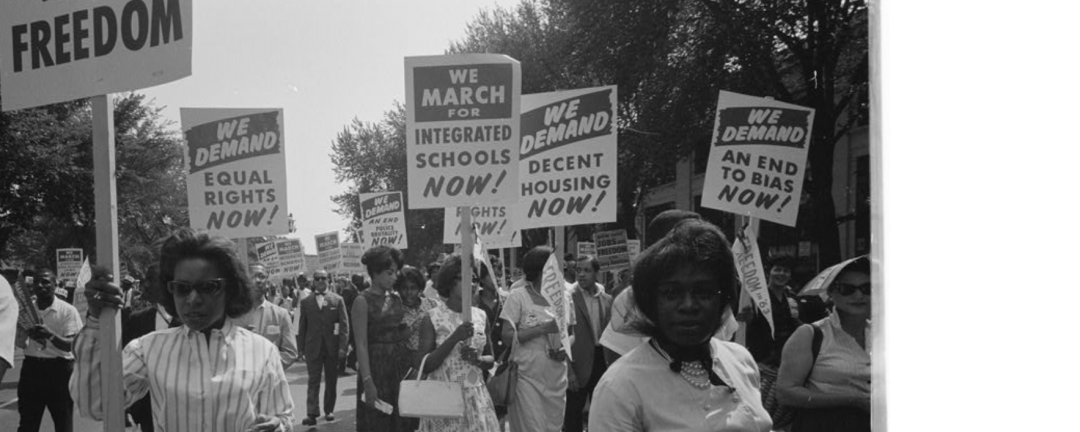
The March on Washington for Jobs and Freedom occurred on August 28, 1963, where over 250,000 people gathered for this movement. In the photograph by the Library of Congress, it shows this event from the Civil Rights Movement which captures the protesters marching peacefully together, holding signs that push for equal rights, good housing, and end of racial discrimination. [1]This photograph sheds light on an important moment in American history and the true planning and aspirations this march had. This photograph overall shows how this march had a lasting impact to the Civil Rights Movement and to the society of the United States of America.
During the 1960s, the Civil Rights Movement was gaining support nationally as African Americans and others used the commonality of working together to inspire legislative change of discrimination. Jim Crow Laws forced Black Americans separated from White Americans in public, schools and transportation. Education between the groups was unequal, where Black Americans suffered schools that were underfunded. There were also tactics that tried to restrict Black Americans from voting like literacy tests and poll taxes. These injustices caused a sense of urgency in African Americans to stop this systemic racism. As one author notes, “…movements benefited from the fact that protests calling for change had been very much in the air for some time,” shedding light on how widespread activism was the foundation for national demonstrations like the March on Washington.[2] Both Philip Randolph and Baynard Rustin organized the march which aimed to call out for federal action on better economic opportunities and no segregation. This was during a time when the Civil Rights Act of 1964 was currently pending in Congress. It brought people together from all over the nation peacefully.
The photograph overall catches a powerful moment of the diverse group of protestors walking together in solidarity with their signs for change in the air. The protestors are dressed modestly with dress shirts and dresses, showing the true seriousness of their march. The signs in the photograph state “We Demand Equal Rights Now!”, “We Demand Decent Housing Now!”, “We March for Integrated Schools Now!”, and “An End to Police Brutality Now!”. The repeated words of “We Demand” and “Now” show the urgency and importance of these messages. This type of language is important since it conveys a direct message to lawmakers during the time. The audience they intended to reach was both the public and political leaders to demonstrate the strength and discipline of this movement. One author states, “The official demands of the protest included passage of Kennedy’s civil rights bill… but marchers also wanted to strengthen the law by requiring all public schools to desegregate by the end of the year, reducing Congressional representation of states where citizens were disfranchised”.[3] This shows that the signs were a good strategy for new legislative changes. The movement has both a peaceful demeanor with a strong force of wanting change, which helps add to the conversation of fighting for equality.
The March on Washington was a demonstration of political strategy. Civil rights leaders used precise planning to show a peaceful but strong message of reform. The photograph has the intent to express the demands of the people. The picture being in black and white also adds to the weight of the message and moment. One author illustrates, “Violence was expected and planned for by city and government officials, but none occurred. Demonstrators assembled peacefully at the Washington Monument and marched singing to the Lincoln Memorial…”.[4] This shows the message of staying disciplined with nonviolence. The march was then just civil rights, but about the economic injustices that followed. The photographer’s picture reinforces that marching for this purpose was pushing for long-term change.
The photograph of the 1963 March on Washington shows a pivotal moment in American history by showing how regular citizens came together for the common good. Through peaceful protesting, these Americans made a stance against the discrimination of Black Americans so they could get basic equality.[5] The image shows emotional power which helped create a change in the nation’s laws for integrated schools and equal housing rights. By continuing to learn more about this image, it can inspire change in the world today, always striving for a better nation.
[1] Leffler, Warren K, photographer. Civil rights March on Washington, D.C. / WKL. Washington D.C, 1963. Photograph. https://www.loc.gov/item/2003654393/.
[2] Tom M. McKersie, “The 1960s Civil Rights Movement and Black Lives Matter: A Comparative Analysis,” New Global Studies 37, no. 3 (2023): 301–318, https://direct.mit.edu/ngtn/article/37/3/301/121488/The-1960s-Civil-Rights-Movement-and-Black-Lives. 2
[3] Jones, William P. 2013. “The Forgotten Radical History of the March on Washington.” Dissent (0012-3846) 60 (2): 74–79. https://doi.org/10.1353/dss.2013.0039. 1
[4] Santoli, Susan Pitts, and Paige Vitulli. “Examining the 1963 March on Washington for Jobs and Freedom through Primary Sources.” Black History Bulletin 75, no. 2 (2012): 7–15. http://www.jstor.org/stable/24759670. 2
[5] Read Martin Luther King Jr.’s ‘I Have a Dream’ Speech in Its Entirety,” NPR, 2023, https://www.npr.org/2010/01/18/122701268/i-have-a-dream-speech-in-its-entirety, 3.