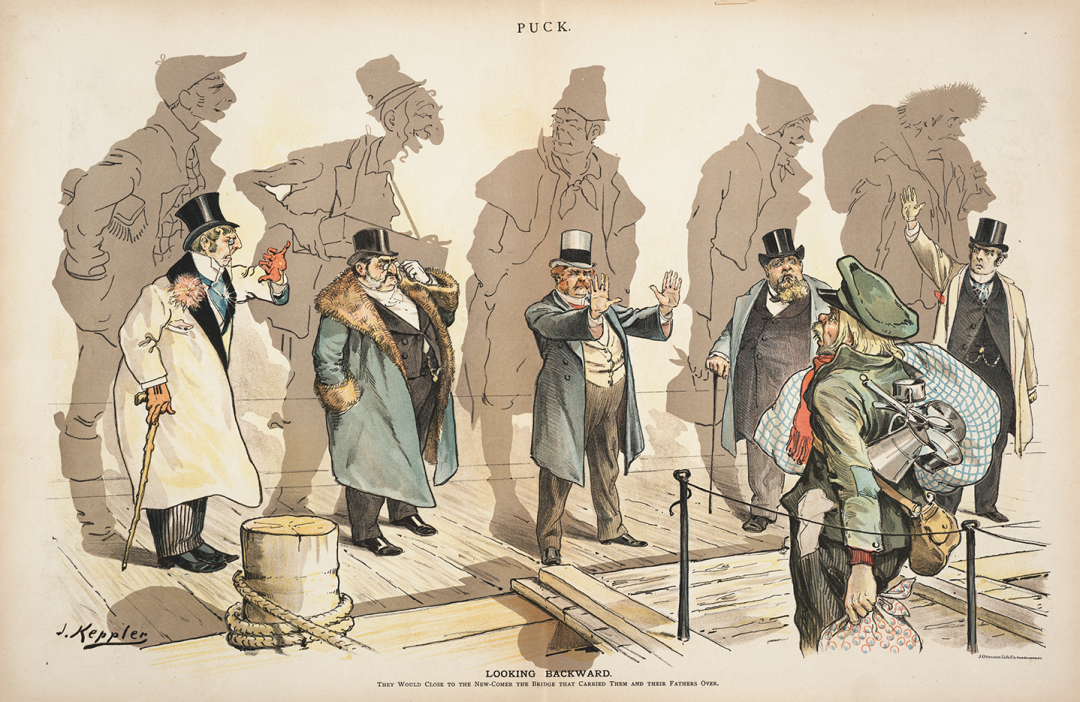
In 1893 Joseph Keppler, published a cartoon titled “Looking Backward” in Puck, a prominent magazine at the time. This cartoon emerged when the nation was having different discussions about immigration and what it meant to truly be American. The cartoon shows a group of men in different nice and expensive articles of clothing trying to prevent a new immigrant from stepping onto the dock on land. Behind each of these figures in their fancy clothes and top hats are faint outlines of what appears to be their ancestors. Who were humble immigrants in simple clothing getting off the boat in America in search of a better life. This cartoon is critiquing the hypocrisy of people who came from immigrant families, who have gained from open and less restricting immigration. As the caption put it “ They would close to the newcomer the bridge that carried them and their father over.”
To understand why this cartoon is so important, you have to look at the history of the late 1800s immigration and how people felt during the time. From the 1880s to the 1920s, the United States saw a surge in new arrivals from southern and eastern Europe. This new influx of people sparked some sort of anxiety among people born in America, people who were born into families who immigrated here and had begun to secure their social standing and identities as Matthew Frye refers to as “white”(1) which “was among the most important possessions one could lay claim to”(1). In Matthew Frye Jacobson’s book he points out that groups like Irish, Italians, and Jewish people were not fully embraced as “white,”(1) when they immigrated but over time their status and how they were perceived changed and that improved their status in American society. Keppler’s cartoon illustrates this transformation to a tee. The men who are dismissing the newcomer are probably Irish, German, or other European immigrants who have now achieved a higher social position and are turning away those who are looking for the same help that they needed and received so their families could be happy and healthy. This time in history was also marked by xenophobia as Americans grappled with questions of national belonging. Erika Lee’s article shows how much of a part xenophobia played in shaping public discussions and creating immigration policies. It gave this xenophobic movement so much power. “By politicizing xenophobia, these groups spearheaded a movement that would turn immigration into a political issue, mobilize voters, and shape policy”(2). This xenophobia meant exclusion and choosing who was considered part of the nation or as Frye put it “white”(1). This xenophobia was also responsible for the creation of laws like the Immigration Act of 1924 which imposed many restrictions on immigration from different regions from Asia to Europe. Keppler’s cartoon touches on this rising xenophobia and exclusion type of attitudes that would eventually lead to these laws to be passed restricting immigration.
When you analyze the cartoon you see this theme of xenophobia at the time being put on display. The tall wealthy men dressed in fur coats and top hats represent earlier immigrants that have used the platform given to them by less restricting immigration policies, and have made a nice living for their families. The cartoon shows them putting their hands up denying entry and looking at the immigrant on the dock as if he is below them. The man coming into the country on the plank is in patched attire and is carrying tools, clearly showing that he is ready to work and is in search of opportunity for a better life just like them. The shadows behind each wealthy man is their immigrant ancestors. Showing that they too were once in their shoes is to me what makes the cartoon truly impactful. They show that these men and their ancestors were once dressed the same and were in search of the same thing as the immigrant they now are turning away. Keppler uses these shadows as rhetorical tools showing how these men are being hypocritical and are halting the progress of the country and the dreams of people who they were just like. The cartoon’s intended audience is the general American public as Puck was a very prominent magazine at the time. But to be more specific this cartoon would probably be geared towards middle to upper class American families, people who at the time were expressing some of this xenophobia.
Overall the cartoon Looking Backwards does what a political cartoon is meant to do, spark conversation and critique certain political agendas that are not beneficial to all. The cartoon also to me does something that not all political cartoons do, which is make people look at themselves as the problem. To me a political cartoon usually targets governments and wrongdoings in terms of war or policy. But this cartoon targets the public, the people who are not accepting everyone as American. It targets bigotry and ignorance that we sadly still see today over 100 years later. And to me that is why this cartoon is so impactful.
Bibliography:
(1) Jacobson, Matthew Frye. Whiteness of a different color: European immigrants and the Alchemy of Race. Cambridge, Mass: Harvard University Press, 2003.
(2) Lee, Erika. “Americans Must Rule America: Xenophobia in the United States.” Social Research: An International Quarterly 88, no. 4 (December 2021): 795–825. https://doi.org/10.1353/sor.2021.0047.