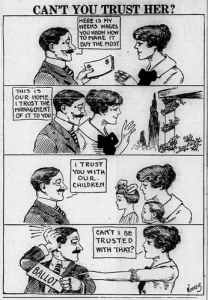
This piece was made on July 30, 1915, by an unknown author. It is a political cartoon that was made in favor of the suffragist movement. In order to understand the cartoon, it is important to know about Women’s Suffrage. Women’s Suffrage was a movement that was started by Elizabeth Cady Stanton and Lucretia Mott in the mid 1800’s. The purpose of the movement was to fight for the women’s right to vote. Some notable suffragists are Alice Paul, Harriet Tubman, Fredrick Douglass, Henry Blackwell and many more. Men helped women gain the right to vote and women helped Black men gain the right to vote. In the late 1860’s, the 15th amendment was written to include all men regardless of race, not women. The amendment was ratified in the following year. After Black men got the right to vote, Women’s Suffrage seemed to be divided when it had come to race related issues. Some women believed that women should’ve been included in the amendment while other women believed that it was important for black men to have the right to vote first. Elizabeth Cady Stanton and Susan B. Anthony, another well-known suffragist, both believed that White women should have the right to vote before Black men. The political cartoon tells us that the suffrage movement wasn’t seen as a societal norm in the Progressive Era. Educated women who were seen as radical at the time and Women’s Suffrage was also seen as radical. The societal norm for women was staying at home and taking care of the house and children, so this idea was radical.
There are four panels in this political cartoon. The first panel shows a husband giving his wife his paycheck and telling her that he thinks she knows how to make the most out of it. In the second panel, the husband is telling his wife that he trusts her to take care of their house. In the third panel, he is telling his wife that he trusts her to raise their children. In the last panel, the wife is asking her husband why he doesn’t trust her with a ballot. The cartoon shows that the author was supportive of Women’s Suffrage. The first three panels show the responsibilities of a housewife in the Progressive Era. The man is trusting his wife with those responsibilities. The author sees voting as a responsibility, so their message is women should be trusted with voting the same way they are trusted to spend money and take care of their home and children. The target audience could be anyone who did not understand the why women feel like they should have the right to vote or those who did not support the Women’s Suffrage Movement. For those who didn’t support the movement, they might have seen this as propaganda and a way to try and get other women to support it. For those who were not against it or had no opinion on it, media such as this political cartoon might have helped them understand and possibly sympathize with the movement.