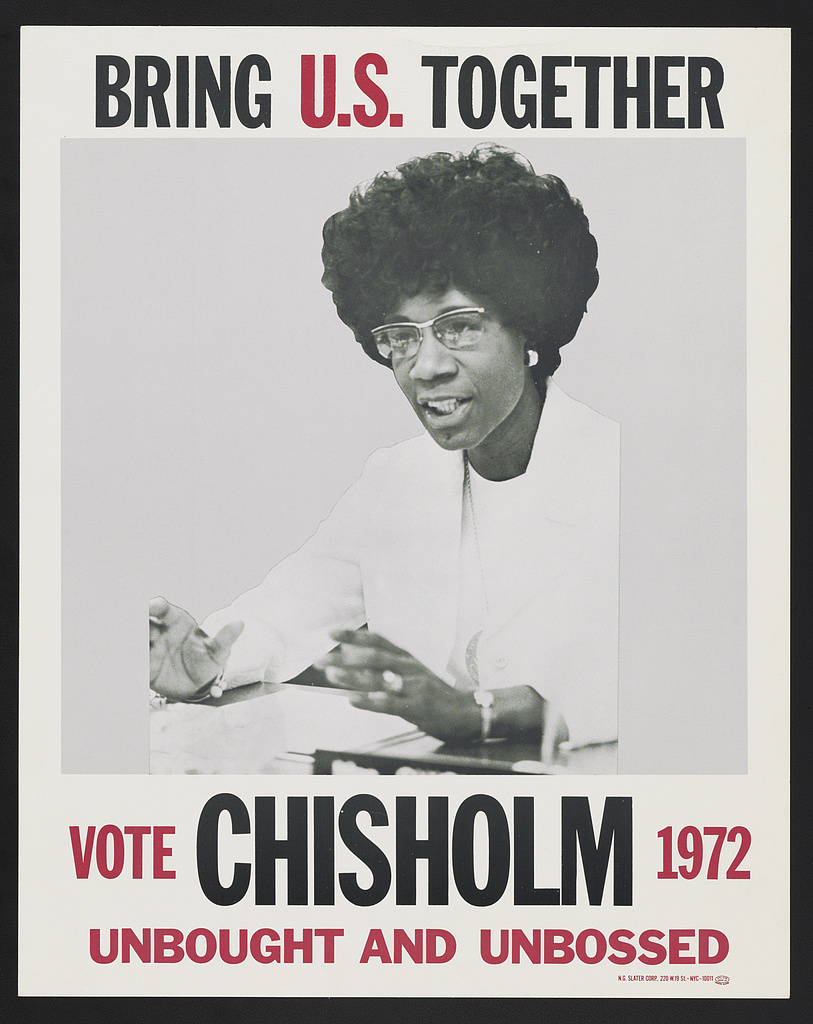
This poster shows a portrait of presidential candidate and U.S. Representative Shirley Chisholm.
The 1972 campaign poster supporting Shirley Chisholm, featuring the slogans “BRING U.S. TOGETHER” and “UNBOUGHT AND UNBOSSED,” originated from her official Chisholm for President campaign committee during the Democratic primary season. Like many political posters of that era, it does not credit a particular designer. Instead, it was created and distributed collectively by the campaign’s communications team and supporting organizations like the National Organization for Women, which helped to amplify Chisholm’s presidential bid. The poster’s purpose was clear: to introduce voters to a candidate who defied political norms and promote her messages of unity, independence, and integrity.
To understand this poster’s historical significance, it is important to consider the political and social culture of the early 1970s. The United States was deeply divided by the Vietnam War, and debates over women’s rights, economic instability, and ongoing struggles for civil rights. Although the 1960s had seen major legislative victories, American political leadership was still overwhelmingly white and male. Chisholm was elected in 1968 as the first Black woman in Congress, entering national politics at a moment when Americans across racial and gender lines felt disconnected from the political establishment. When she announced her campaign, she declared it marked “a new era in American political history… Americans all over are demanding a new sensibility, a new philosophy.”¹
The poster’s design reinforces that call for a new direction in the monotonous establishment. The phrase “BRING U.S. TOGETHER” uses color to highlight the U.S., causing viewers to read it as both “us” and “United States.” This double meaning reflects her appeal to national unity at a time of social upheaval. Tammy Brown explains that Chisholm’s appeal relied on her unique ability to “reconcile seemingly contradictory philosophies of racial, ethnic, and feminist pride with humanist and universalist ideals.”¹ This poster reflects that balance as Chisholm stands proudly as a Black woman candidate, inviting all Americans into a shared political vision.
The bottom slogan, “UNBOUGHT AND UNBOSSED,” was not just a catchphrase attached to the campaign but the defining statement of her political identity. In a political era filled with corruption and backroom deals, Chisholm emphasized her independence from party machines and elite donors. Anastasia Curwood writes that the slogan was “a powerful statement of her personhood as a black woman” and a direct challenge to “widespread cronyism in the Democratic establishment.”² By printing the phrase in red capital letters, the poster couples integrity to urgency and patriotic responsibility.
The composition of the image further communicates Chisholm’s political message. She is shown seated at a desk, mid-gesture, wearing a crisp white suit against a plain background. There are no flags, staged crowds, or elaborate props, like other posters of the time, only Chisholm herself in an active moment of thought and explanation. This choice pushes back against entrenched stereotypes of Black women in American culture. As Carole Boyce Davies observes, Black women leaders have historically been “marginalized” and written out of political history.³ By centering Chisholm alone and highlighting her intellect, the poster asserts her legitimacy as a potential leader of the free world.
Chisholm’s candidacy also reflected the rise of Black feminist political thought during this period. Curwood notes that Chisholm viewed racism, sexism, and economic inequality as interconnected forces, emphasizing her belief that “antiblack, antifemale, and all forms of discrimination are equivalent to the same thing—antihumanism.”² The poster’s call to “bring U.S. together” echoes this idea that political unity must be rooted in justice and inclusion. Although Chisholm did not win the Democratic nomination, her campaign reshaped American political imagination. The poster stands as a visual representation of that transformation. It is bold in its colors, a stripped-down composition, and firm in its insistence that political leadership belongs to all Americans, not just those who have historically held power. As Brown highlights, Chisholm became “a new face and a refreshingly candid voice” to citizens craving honesty in government.¹
For those viewing this campaign poster today, it stands as more than a campaign artifact but as a testament to the enduring struggle for representation and equality in American politics. Its message of unity, integrity, and courage continues to resonate in a country still wrestling with questions of democracy and inclusion. Shirley Chisholm’s call to “Bring U.S. Together” remains as urgent now as it was in 1972.
Footnotes
1Tammy L. Brown, “‘A New Era in American Politics’: Shirley Chisholm and the Discourse of Identity,” Callaloo 31, no. 4 (2008): 1013–1025.
2Anastasia Curwood, “Black Feminism on Capitol Hill: Shirley Chisholm and Movement Politics, 1968–1984,” Meridians 13, no. 1 (2015): 204–232.
3Carole Boyce Davies, “‘She Wants the Black Man Post’: Constructions of Race, Sexuality and Political Leadership in Popular Culture,” Agenda 25, no. 4 (2011): 121–133.