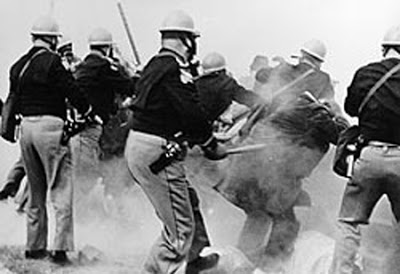
Bloody Sunday: Alabama Police Attack, an FBI photograph taken in March 1965, captures one of the most violent and consequential moments of the Civil Rights Movement. The image exhibits Alabama State Troopers in Selma, Alabama, attacking nonviolent protestors. These protestors had gathered to exercise their First Amendment right to assemble and advocate for voting rights. They were violently met with clubs, tear gas, and aggressive troopers who charged directly into them.
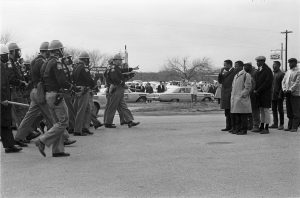
Protestors remained calm as the troops drew their weapons at them
Photographs, like this one, documented and brought to light the racism and outright cruel, racial brutality that African Americans in the South experienced living under Jim Crow laws. Jim Crow laws were state and local discriminatory laws in the South United States that were upheld into the 1960s. These laws forced racial separation between African Americans and White people in public areas, schools, and transportation. In these places, there were often signs reading “Whites only,” in which a Black person would be arrested or harmed if they sat in the segregated area. Images of this kind played an essential role in changing how Americans understood the racial injustices occurring throughout the country.
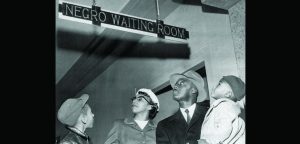
Segregated signs, due to Jim Crow laws
To understand why this photograph is so significant, it is necessary to examine the broader historical context. Although the Fifteenth Amendment granted African American men the right to vote in 1870, Black citizens in the Deep South continued to face numerous barriers that prevented them from registering. These obstacles, such as literacy tests, poll taxes, threats, and violence, kept registration rates extremely low. In Selma, only about two percent of eligible Black residents were registered to vote.³ Civil rights organizations such as the Student Nonviolent Coordinating Committee (SNCC) and the Southern Christian Leadership Conference (SCLC) chose Selma deliberately to expose just how systematically African Americans were being denied access to the ballot. Local officials were notoriously resistant to desegregation, and activists hoped that confronting this resistance publicly would highlight the gap between American democratic ideals and the lived realities of Black citizens.⁵ On March 7, 1965, roughly 600 protesters gathered for the first of three planned marches from Selma to Montgomery. They sought justice for the killing of civil rights activist Jimmie Lee Jackson and demanded federal protection for voting rights. Led by John Lewis of SNCC and Hosea Williams of SCLC, the marchers proceeded peacefully until they reached the Edmund Pettus Bridge, where they came face-to-face with a line of Alabama State Troopers blocking the roadway. Within moments, the troopers advanced and became more aggressive and violent, in which they proceeded to beat the marchers with clubs, burn their eyes with tear gas, and perform other brutal actions. This attack resulted in the injury of more than forty people. John Lewis himself suffered a fractured skull during the assault.⁶ The FBI photograph captures the chaos of those moments, preserving both the terror the marchers endured and the extraordinary courage they displayed.
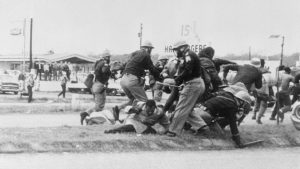
Police brutality on helpless protestors
A significant strength of this primary source lies in the role images of Bloody Sunday played in shaping public perception and influencing political action. National television news crews were on the scene, present to record the attacks, with the severely upsetting footage being broadcast across the country for all Americans to see. Historian Juan Williams notes that many Americans saw the violence on television for the first time and were shocked by the brutality inflicted on peaceful citizens. The racism of African Americans varied across states, with the South being the worst. Americans living in the North and in more “liberal” states were shielded from the worst racism that often occurred in the South. Rightfully so, this widespread reaction created an immediate wave of public outrage. Many people had previously been unaware of the depth of racial oppression in the South and began pressuring the federal government to intervene. They turned their ignorance into decisive action. Thus, the events of Bloody Sunday directly contributed to the passage of the Voting Rights Act of 1965, one of the most significant legislative achievements in U.S. civil rights history. Historian David Garrow explains that the violence in Selma provided President Lyndon B. Johnson with the political momentum needed to introduce sweeping voting rights legislation.⁶ In a Lyndon Johnson’s March 15 televised address to the nation, Johnson invoked Selma and declared, “We shall overcome,” publicly aligning himself with the movement. Without the graphic images captured that day, federal action may not have come as swiftly or as forcefully.
This photograph belongs in the Virtual Museum of American History because it demonstrates the power of visual documentation to expose injustice and inspire change. As Clayborne Carson observed, SNCC activists believed that nonviolent protest, especially when answered with violence, would reveal the moral contradictions of segregation. Their strategy proved effective. The photograph reminds us of the tremendous risks taken by ordinary citizens, students, pastors, factory workers, and community members, who stood up for fundamental democratic rights. Despite the image being captured in the 1960s, it still showcases the ongoing issues in the United States today, especially highlighting police violence and racial inequality. Bloody Sunday: Alabama Police Attack is a reminder to this day of the horror and violence behind racism for people of all races to obtain equality. It serves as a moral reminder to Americans never to forget the struggle brave Americans endured to fight for the end of racial discrimination, prejudice, and equal voting rights.
¹ General historical background on Jim Crow and racial violence is widely documented; see William’s discussion of televised brutality: Juan Williams, “Bloody Sunday: Selma and the Struggle for Voting Rights,” American Scholar 64, no. 4 (1995): 553–559.
² Williams, “Bloody Sunday,” 554.
³ Clayborne Carson, In Struggle: SNCC and the Black Awakening of the 1960s (Cambridge, MA: Harvard University Press, 1981), 93–95.
⁴ Williams, “Bloody Sunday,” 555.
⁵ Williams, 557.
⁶ David J. Garrow, Protest at Selma: Martin Luther King, Jr., and the Voting Rights Act of 1965 (New Haven: Yale University Press, 1978), 45–47.
⁷ Carson, In Struggle, 118.